
Create your own music: The basics of waveforms
Posted by Unknown | Posted in
Learning music software usually means learning at lease some details about electronic music. Electronic music was originally done on tapes, and started out horribly. Over time, it evolved as synthesizers were created and improved upon. Computers became capable of synthesis as well, and eventually DAWs came into existence. Early DAWs were really limited trackers, but into the 90's and beyond they became much more versatile.
Electronic music is produced by manipulating waveforms. This is a lot easier than it sounds. There are few different types of basic waveforms:
Sine Wave
Sine waves are derived from circles. They're smooth and pleasing to the ear, but aren't used in much more than bass sounds and certain high pitched leads. They can make nice, reverberating sounds with long decays, giving your music a kind of ethereal sound.

Sine waves are a lot of fun to play with. Setting up a 3-deep delay and letting loose with them can be really enjoyable, and might help you come up with some neat ideas.
Triangle Wave
Triangle waves look a little similar to sine waves, but sound significantly different. They're used often for deep bass sounds, or certain high-pitched leads. Using triangle waves in arpeggios or specific leads can be interesting, and the only way to find out if it'll work is to try it out. You might be surprised.

A lot of people feel really limited to using triangle waves as bass sounds only. Try to be a little creative with them if you can.
Square Wave
Square waves are usually used as leads. They're very much the most distinct sound to ever come out of electronic music. They can be manipulated by changing the duty cycle (how wide or narrow they are), giving them a very specific sound tailored to each song.
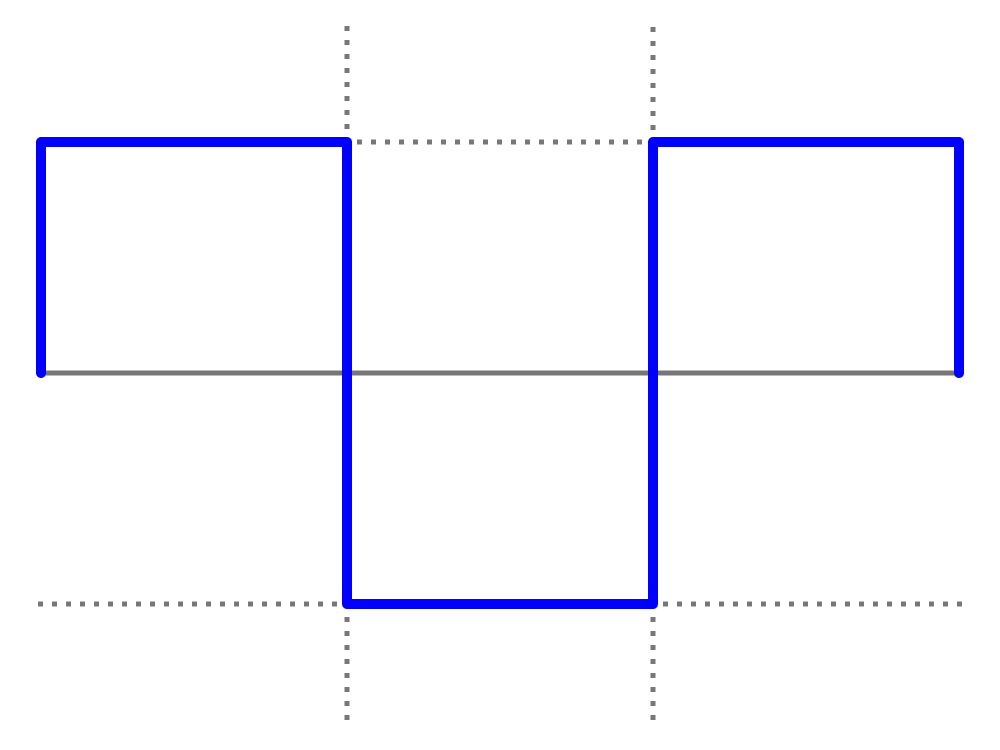
A square bass can sound very interesting, very "crunchy", or harsh. Take note, square waves can often be quite jarring without some sort of accompaniment.
Saw Wave
A saw wave, or sawtooth wave, is also used as a lead more often than not. They have a harsh, almost noisy sound. This can be great in a lot of situations, but caution is still advised. They can also be worse than square waves if used improperly.

These look like a mix between square and triangle waves. They have their own distinct quality, however.
You'll often use all of these in one form or another in your music, usually mixing them together to create something totally unique. It gets a lot more complicated than just raw waveforms, but learning about these is a great way to start.
If you want to learn more about them, just listen! Start up your favorite free music software and load up a synth with each wave. You can create your own music in no time!

Comments (0)
Post a Comment